


The Google ads team is recruiting a GEO Partner Manager, while Google Search publicly insists that GEO does not exist. That is not a language confusion. That is a market signal.
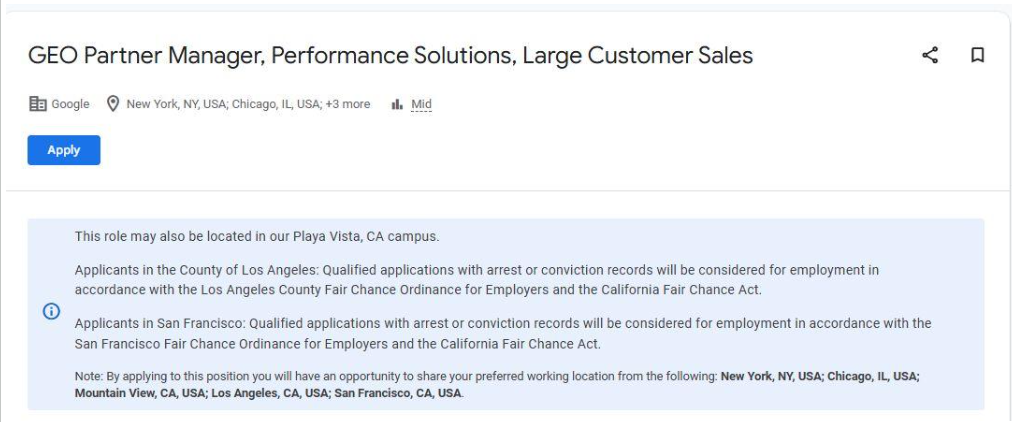
On April 28 published by Search Engine Journal A brief finding that gained traction in the SEO bubble: Google's Large Customer Sales team has posted a vacancy for a “GEO Partner Manager, Performance Solutions”. The term “GEO” appears seven times in the text. “Generative Engine Optimization” is written out in full twice. The role must, in the words of the vacancy itself, “shape the GEO ecosystem so that Google surfaces are prioritised”.
This is one word. But words in Google job adverts are never accidental.
Until last week, Google's official line was: GEO doesn't exist as a separate discipline. Standard SEO is enough. Last week, that became an internal contradiction.
Two teams. Two stories. One company.
In July 2025, Gary Illyes, one of the most vocal voices from Google Search, stated that specific optimisation for AI Overviews and AI Mode is not necessary. Those who do good SEO are done. AEO and GEO are terms for consultants who want to sell something. That position has not been publicly revised since then.
At the same time, Google's ads organisation is now actively looking for someone to manage the GEO ecosystem. influence. Partner tools, methodologies, and what the industry calls “Share of Model” (the extent to which a brand is mentioned in AI responses). The same Share of Model that Google’s Search team does not formally recognise as a category.
One department says: this is nothing. The other department recruits someone to influence it.
This is not the first time that Google's internal signals have contradicted each other. It is, however, the first time that it concerns this category.
The contrast in one line:
| Bron | Google Søg (juli 2025) | Google Ads (April 2026) |
|---|---|---|
| Position on GEO | No need. Standard SEO is sufficient for AI Overviews and AI Mode. | Category is mentioned seven times in a live vacancy; role must influence partners. |
| Model Share Recognition | No formal category within Search guidance. | Explicit part of the job description. |
| Target | No optimisation needed. | Give Google surfaces priority within third-party tools. |
| Implication | Nothing to see. Move along. | Plenty to see to put someone on it full-time. |
Sources: Search Engine Journal (28-04-2026); Google Careers; SEJ’s reporting of Gary Illyes’ statements (July 2025).
One vacancy is not a change in policy. But it's not nothing either.
Let's be honest about the proportions. This is one role, in one team, within one department at Google. It's not a documentation update. It's not a statement from Google Search. It's not a policy change. Anyone making this into “Google confirms GEO!” right now is exaggerating.
But anyone dismissing the news as mere HR jargon is missing the pattern. Microsoft in March 2025 GEO formally added to Bing webmaster guidelines as a named category alongside SEO. Bing’s AI Performance Dashboard rolled out in February 2025. Google’s Search organisation remains formally silent, while Google’s ads organisation is now internally seeking staff to influence it.
That's not a company-wide signal. That's a team that's already gone beyond the official narrative.
Microsoft publicly acknowledges GEO. Google's ads team is recruiting on the term. Google Search denies the term exists. Which of those three will change their stance first?
The $100 billion claim: What it does and does not say
Running concurrently with the SEJ finding, another article is circulating: “GEO vs SEO: The $100 Billion Shift Every Brand Is Ignoring”. The article frames GEO as a shift from publishing to being cited, and uses $100 billion as an indicator of market size. The figure stands out. That is why it deserves to be read with a critical eye.
Origins: A Huibo Research projection that the global GEO market is more than $100 billion by 2030 Sweetheart. That is a five-year forecast, not current market size. The figure is not a confirmation that GEO “is already” a 100-billion market. It is a projection of where the discipline could grow according to analysts.
That distinction is important. Because the difference between “the market is $100B” and “the market could reach $100B in four years” is precisely the difference between falling behind and staying ahead of the curve.
What one vacancy at Google and one market projection tell us together
Strangely, these are two inconspicuous articles. An HR news item and an opinion piece. Together, they form one coherent story:
- The infrastructure is shifting. A measurable portion of query-to-answer search behaviour is now happening via LLMs. Bing publicly acknowledges this, Google's ads team internally, but Google Search has not yet done so publicly.
- The terminology is stabilising. “GEO” is no longer just a consultant term and is appearing in Google job postings, Microsoft's guidelines, and analyst reports.
- Budgets are set to shift. A $100B projection to 2030 suggests that enterprise, marketing and recruitment budgets will be reallocated in 2026 and 2027. Brands that position themselves early will become the default choices in the models that will soon be used at scale.
The brands that will soon be the standard answers in ChatGPT, Perplexity, Gemini and Google's own AI interfaces are the brands that are already being found, read and cited now, while the official narrative is still faltering.
Three scenarios. One choice.
If you are a marketing or recruitment leader, this development falls into one of three positions:
| Position | What it entails | Risk in 2026–2027 |
|---|---|---|
| Waiting | Sticking to Google's current search position: standard SEO is enough. | Competitors are becoming the default answers in LLMs. Overtaking them will therefore cost multiples. |
| Investing | Set up GEO as a parallel discipline to SEO; measure by citation and mention, not just by traffic. | Higher costs in the short term, but acquired positions that last for years in training data. |
| Dominate | Categorically claiming ownership: original research, structured authority sources, citations on platforms that process LLMs. | First-mover advantage that is difficult to replicate by late starters. |
Three questions that sharpen the discussion
- What do ChatGPT, Perplexity, or Google's AI Mode answer to the question “Who is the best supplier for [your category]?” and do you feature in that answer?
- How much of your content is written to be found, and how much to be cited? Those aren't the same things.
- If Google's own ads team already measures Share of Model internally, why would your marketing team not be doing that yet?
What you should take away from this
One vacancy proves nothing. One market projection proves nothing. But together they form a pattern that has been visible for some time and is now being confirmed from several directions simultaneously.
Microsoft recognises GEO. Google’s ads team is banking on it. Analysts are forecasting $100 billion. And Google Search? It still says: nothing to see here. Don't forget which part of Google spends the most time on enterprise client ad budgets.
The question is no longer whether GEO will become a category. The only question is which team at Google will be the first to admit it publicly.
How AI Rebels stands on this
AI Rebels is built for precisely this shift. We measure, monitor, and optimise how your brand appears in the answers of ChatGPT, Perplexity, Gemini, Microsoft Copilot, and Google’s AI surfaces. Not as a theory. As a service.
SOURCES
- Search Engine Journal (28-04-2026): “Google Ads Posts GEO Partner Manager Role.” Matt G. Southern. Accessed via searchenginejournal.com.
- Huibo Research (geciteerd via Medium, April 2026): GEO Market Projection to 2030.
- Google Careers: Vacancy 137839919761367750 — “GEO Partner Manager, Performance Solutions, Large Customer Sales.”
- Search Engine Journal (July 2025): “Google Says You Don’t Need AEO or GEO to Rank in AI Overviews.”
- Search Engine Journal (March 2025): “Bing Adds Geo To Official Guidelines.”